


#stopthepressure 2025: Advancing Pressure Injury Prevention with Unicare Health
Seminar: Pressure Injury Care
- Global Trends & New Approaches
Wednesday, 19 November 2025
Technology Park, Bentley

There’s a special day each November that brings allied health professionals together around a shared goal: pressure injury prevention.

Worldwide Pressure Injury Prevention Day is held on the third Thursday of November each year, and since 2019, Unicare Health has proudly marked the occasion by hosting its annual #stopthepressure education days. On 19 November 2025, we welcomed more than 130 therapists to our seventh #stopthepressure event, coming together for a full day of learning, collaboration and clinical discussion focused on best practice pressure injury prevention.

As medical knowledge continues to evolve, the evidence is increasingly clear: many pressure injuries are predictable and, importantly, preventable. Achieving this on a broad scale relies on education, shared knowledge and the translation of evidence into real-world practice. This philosophy sits at the heart of our #stopthepressure days and underpins everything we do at Unicare.

Evidence, education and global perspectives
This year’s event opened with a strong clinical foundation, grounded in the Pressure Injury International Guidelines. We were privileged to welcome Tracy Nowicki, Clinical Nurse Consultant, who brought a well-rounded perspective to pressure injury care through evidence-based assessment and management strategies. Tracy reinforced a key theme for the day: pressure injuries do not occur at random. With over 126 identified risk factors, prevention requires clinicians to take a holistic, individualised approach that considers the person, their environment and their care context.

Pressure injuries can affect people of any age – from infants through to older adults – and once tissue damage has occurred, the impact can be lifelong. Even when a wound heals, the affected area remains vulnerable, with scar tissue that is more susceptible to future breakdown. Tracy also highlighted the importance of consistent terminology and staging, including the fact that pressure injuries cannot be back-staged, reinforcing why shared education is critical if we are to work towards a pressure injury–free future.

From assessment to action
With assessment principles established in the morning, the afternoon sessions focused on translating clinical reasoning into effective equipment prescription.

Unicare’s Head of Education and Sleep Support Surfaces Educator, Ilissa Liew, led the transition from theory to practice by exploring how mattress selection plays a critical role in both prevention and active treatment of pressure injuries. Therapists were guided through key considerations including diagnosis and prognosis, pressure injury risk and history, client weight, mobility, pain, continence, transfer ability and the level of support available in the home.

Ilissa showcased the Care of Sweden mattress range, demonstrating how different foam and air systems can address multiple risk factors simultaneously. Concepts such as shear reduction, immersion, envelopment and microclimate management were explored, alongside practical positioning strategies like limiting head-of-bed elevation and supporting knee positioning to minimise sliding and shear forces. When paired with the Unicare Xcel 3 electric profiling bed range on display, therapists could clearly see how bed function and support surfaces work together to optimise pressure care, transfers and overall comfort.

Managing pressure in seating
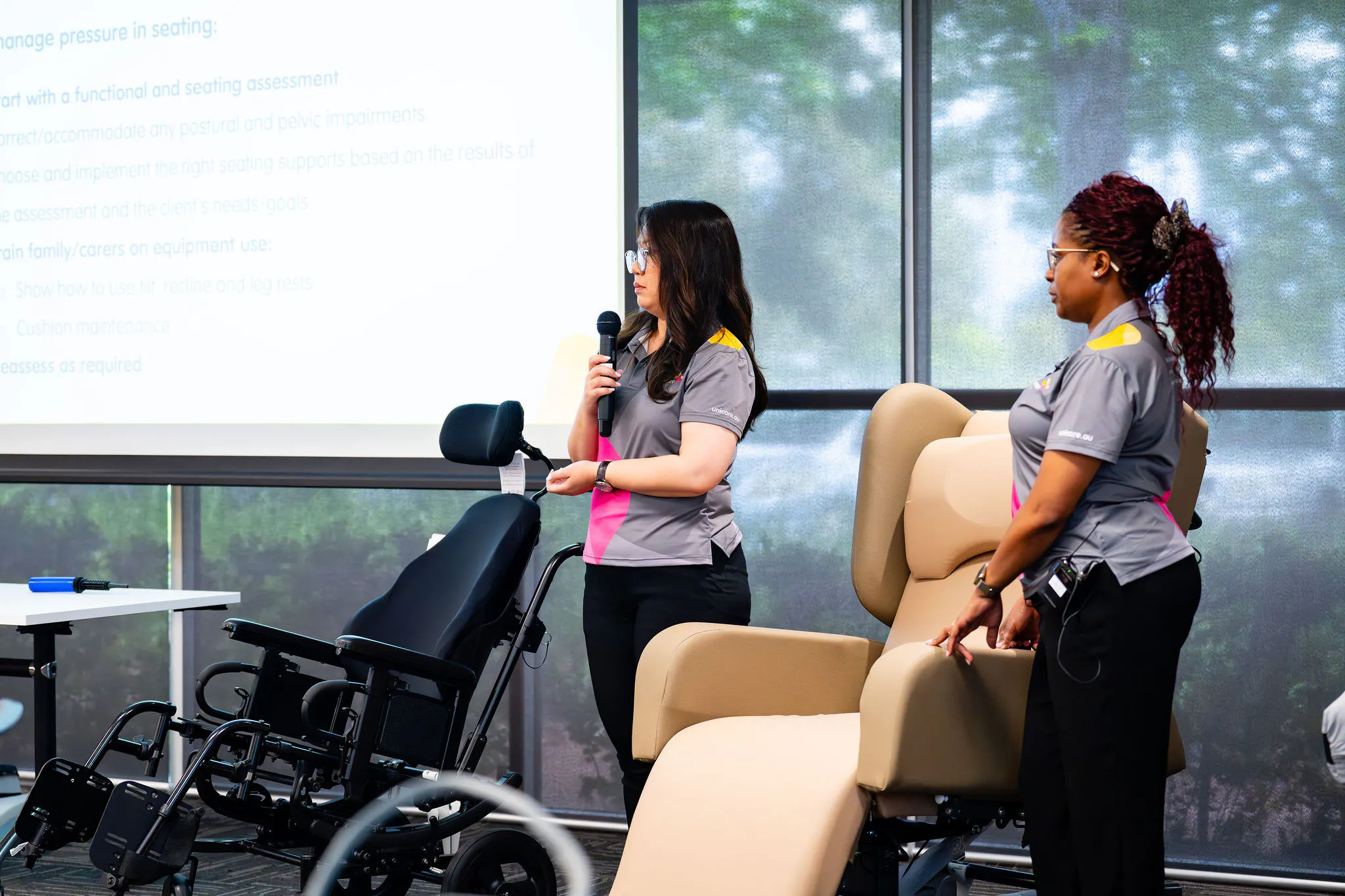
Next, Unicare’s Seating Solutions Educator, Caroline Khama, took the spotlight with a comprehensive session on managing pressure in seating. In an upright position, a significant proportion of body weight is concentrated through the pelvis and thighs, increasing pressure over bony prominences such as the ischial tuberosities and sacrum. For people with impaired sensation, postural asymmetries or limited ability to reposition, this creates a heightened risk of pressure injury.

Caroline emphasised the importance of holistic seating assessment, prioritising posture, pelvic alignment, pressure redistribution and positioning needs. Therapists explored dynamic weight-shifting strategies including tilt, recline and elevating leg rests, as well as the clinical benefits of different cushion materials such as foam, gel, fluid, elastomer, air and hybrid designs.


One of Unicare’s latest seating developments, the Carer Chair, was available for hands-on experience, allowing therapists to trial features firsthand and consider real-world application for clients with complex pressure care and positioning needs.
Pressure care in the bathroom
Rounding out the clinical program, Bathroom Mobility Solutions Educator Crystal Chan addressed pressure care considerations in shower commode prescription. Crystal walked attendees through the critical factors to assess before prescribing, including pressure injury risk areas, posture, mobility, body shape and weight distribution, environmental constraints and the individual’s care goals.

The session highlighted the extensive customisation options available within the JUVO shower commode range, from seat dimensions and apertures through to back, arm and leg supports. By tailoring equipment to the individual, therapists can significantly reduce pressure risk in environments that are often overlooked but present real challenges.

Innovation, connection and collaboration
Throughout the day, the Unicare clinical team were on hand with a conference room full of pressure care equipment, giving therapists the opportunity to ask questions, trial products and connect directly with educators and specialists across departments. The Showroom at Home™ van was also on site, sparking conversations about how easy it is to book an in-home trial now.


Attendees also heard from Unicare Key Accounts Manager Stephanie, who shared updates on Unicare services and introduced the newly launched Unicare for Business platform. The streamlined online portal generated strong interest, offering therapists an easier way to explore products, manage clients, generate quotes and place orders all in one place.

Over a gourmet lunch and informal discussions, therapists connected with Unicare team members from all departments to explore how their evolving services and technology can better support clinical practice.

Thank you
As another successful #stopthepressure day came to a close, attendees left with refreshed knowledge, practical strategies and a deeper understanding of how assessment, equipment and education come together to prevent pressure injuries.

We are incredibly grateful to our growing allied health community for continuing to learn, share and collaborate with us. A special thank you to Tracy Nowicki for generously sharing her expertise and global insights – your contribution was invaluable.

Together, we move one step closer to a future without pressure injuries.

Next Steps
Subscribe to our newsletter and follow us on social to stay informed about #StopThePressure training events.


